The Plane, Metaxis and the Drift Zone
The Plane
The Metacentrist view of reality is represented by a two-axis coordinate system called the Agency–Abstraction Plane.
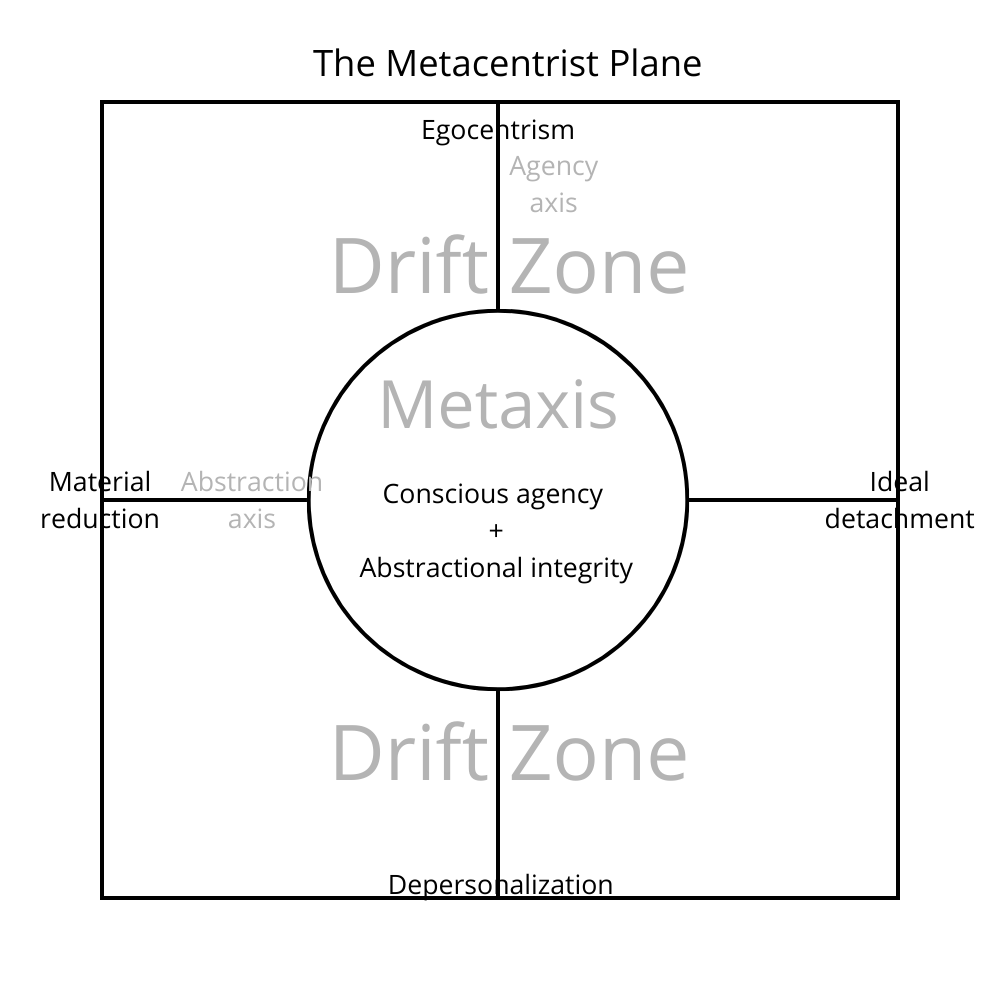
The vertical axis represents Agency. It ranges from Depersonalization at the lower end to Egocentrism at the upper end. The central area of this axis is Consciousness.
The horizontal axis represents Abstraction. It ranges from Material reduction on the left to Ideal detachment on the right. The central area of this axis is Integrity.
You can take the Metacentrist Test to determine your current position on the plane. To understand your result, read the descriptions of Metaxis and the different forms of drift below.
Metaxis
Metaxis is the central area of the plane. It symbolizes the combination of both central conditions: Consciousness in Agency and Integrity in Abstraction.
Consciousness means being humble enough not to become egocentric and confident enough not to become depersonalized.
Integrity means having strong enough convictions not to be consumed by material reduction and strong enough ties to reality not to be consumed by ideal detachment.
In Metacentrism, Metaxis is happiness. Happiness is the state in which Agency and Abstraction are balanced, so both Consciousness and Integrity are achieved.
Metaxis is not a mathematical point but an area. Life involves fluctuation and variation. A person can move within limits while preserving both Consciousness and Integrity. The width of this central area depends on the individual — on how much movement they can tolerate without losing structural balance.
Metaxis does not mean neutrality, indecision, or mediocrity. It is not the absence of conviction. It is the condition in which conviction remains connected to reality, and agency remains firm without becoming domineering or dissolving. Naturally, we are drawn towards Metaxis.
All positions outside of Metaxis represent some degree of imbalance, though degrees vary significantly. Slight deviation is not equivalent to extreme drift.
The Drift Zone
The Drift Zone is the area that surrounds Metaxis. It represents the weakening or absence of integrated balance. Drift Zone begins when self-rebalancing capacity is exceeded.
Drift is gradual, not binary. Imbalance intensifies with distance from the center. The further one moves from Metaxis, the more one extreme begins to dominate.
A drifter is a person currently located in the Drift Zone. This is a condition, not an identity. Drift indicates structural imbalance, not essence.
Single-Axis Drifts
Materialist
Located on the left side of the plane. Material reduction dominates Abstraction.
- Choosing a high-paying job you dislike solely for income.
- Staying in a relationship primarily for financial security.
- Ignoring ethical concerns because “money is what matters.”
Idealist
Located on the right side of the plane. Ideal detachment dominates Abstraction.
- Refusing medical treatment due to abstract belief.
- Neglecting obligations while immersed in theory or fantasy.
- Rejecting stable work without alternative plan.
Egocentric
Located in the upper half of the plane. Agency becomes dominating.
- Yelling instead of explaining patiently.
- Taking credit for group work.
- Refusing to admit error despite evidence.
Depersonalized
Located in the lower half of the plane. Agency weakens or dissolves.
- Remaining silent when insulted.
- Letting others decide for you.
- Avoiding confrontation when important values are dismissed.
Compound Drifts (Corner Positions)
Compound drifts occur when imbalance dominates on both axes simultaneously. These are located in the corners of the plane.
Egocentric Materialist
- Manipulating coworkers for promotion.
- Bullying competitors.
- Justifying exploitation as “survival of the fittest.”
Egocentric Idealist
- Imposing strict ideology on family.
- Publicly shaming dissenters.
- Refusing dialogue because you believe you are unquestionably right.
Depersonalized Materialist
- Remaining in degrading job for security.
- Staying in harmful relationship from fear.
- Developing addiction.
Depersonalized Idealist
- Blindly following a cult.
- Doom-scrolling compulsively.
- Accepting injustice as inevitable or illusory.
Compound drifts are generally more destabilizing than single-axis drifts, because both structural dimensions are compromised simultaneously.
Reading Your Test Result
Your position on the plane indicates:
- Direction — type of imbalance or integration.
- Distance from center — intensity of drift.
- Quadrant or side — single-axis or compound drift.
Positions close to the center indicate balance. Positions further away indicate increasing dominance of extremes. Corner positions indicate compound drift.
For deeper analysis and guidance on restoring balance, consult the recommendations entry.